

Research Projects:
- Large Eddy Simulations of Jets in Cross-Flow:
- Reduced-Order Modeling of Combustion Systems:
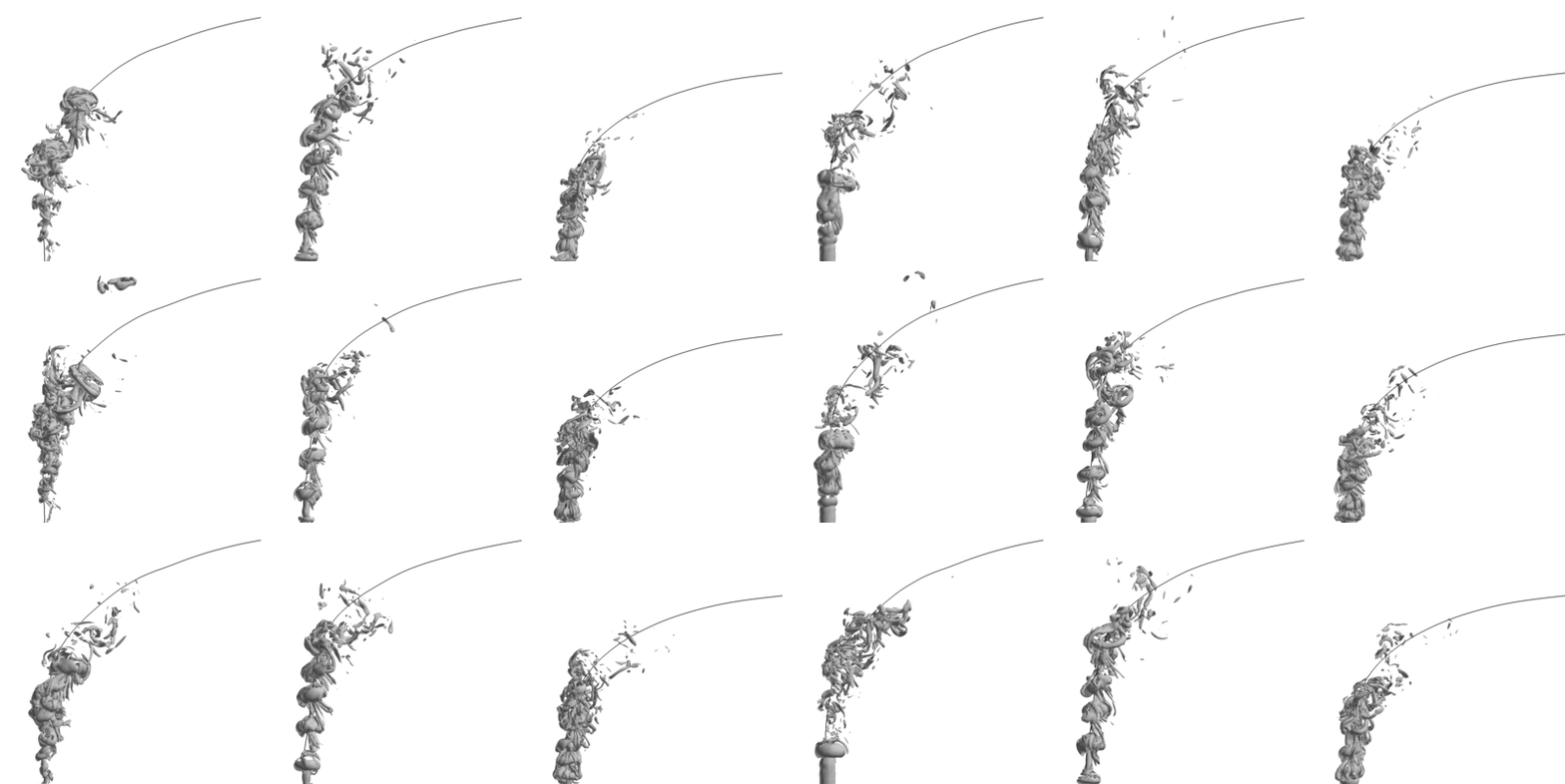
The jet in cross-flow (JICF) is a canonical flow problem because it displays many important physical phenomena and also has many practical applications. It is particularly relevant to many combustion systems where fuel is injected into cross-flowing air. The penetration of the fuel and the the rate at which it mixes with the air are of critical importance to the performance and tability of the system. Many practical applications of JICF occur at very high pressures and temperatures, above the critical pressure and temperature of the mixture. At these supercritical conditions the ideal gas assumption is no longer valid and more complex models, known as real gas equations of state, are needed. In the current work, large-eddy simulations combined with the Peng-Robinson equation of state are used to simulate the injection of Jet-A fuel into a high-temperature, high-pressure, cross-flow of air. Results are compared with experiments that injected liquid fuel into air at the same conditions. The most important non-dimensional parameter for JICF simulations is the ratio of the momentum of the jet to the momentum of the cross-flowing fluid. Experimental results are available for momentum ratios between 5 and 40, and simulations have been performed for momentum ratios of 10 and 20. Two different injectors have been considered: a flush-mounted injector and an injector mounted at the bottom of a circular recess. The maximum penetration of the jet is predicted well for the flush-mounted injector with a momentum ratio of 10. This solver is also used to simulate the same conditions using the ideal gas equation of state, and a second solver called Gerris is used to simulate a liquid jet at the same momentum ratio. The three different simulations are compared to show the effects of surface tension and compressibility on the JICF.
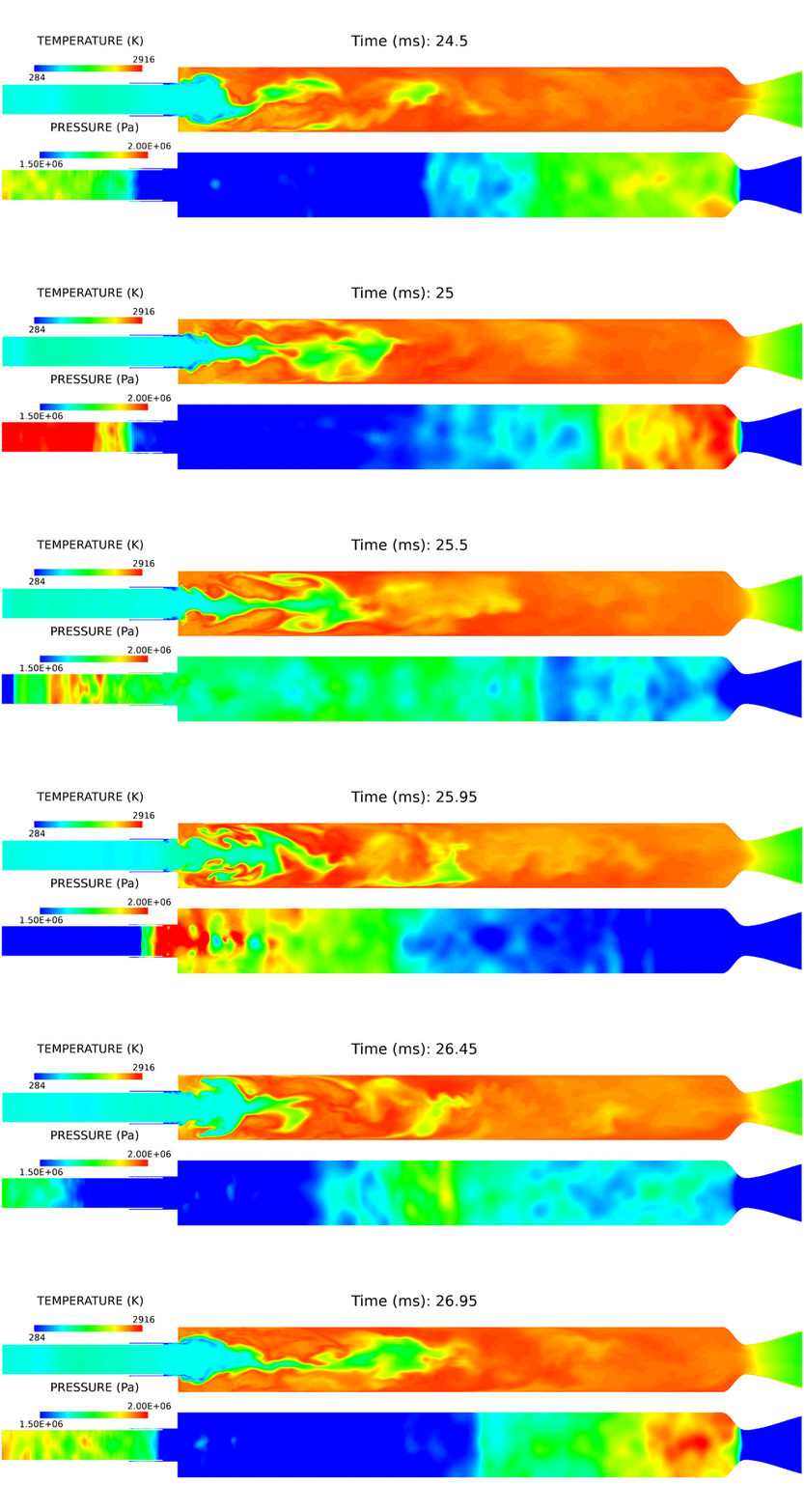
Reduced-order modeling (ROM) is a term used for a range of models that reduce the complexity of a mathematical problem to make it much less expensive to solve. A common application of these types of models is in combustion systems where acoustic instabilities are of concern. Complex three-dimensional systems can be reduced to one-dimensional equations that can predict the frequency and stability of oscillations in the system. This allows calculations for a range of parameters that would be too costly to perform using full three-dimensional simulations. A one-dimensional acoustic model for reacting flow has been developed and will be used to predict combustion instabilities in a continuously variable resonance chamber (CVRC). Large-eddy simulation (LES) results will be used to provide time-averaged fields of physical properties, as well as unsteady data on which a flame model can be based. A similar approach will be used for the lean direct injection (LDI) combustor, but a two-dimensional model will be used because of the significant amount of swirl in this system.