

Balaji Muralidharan
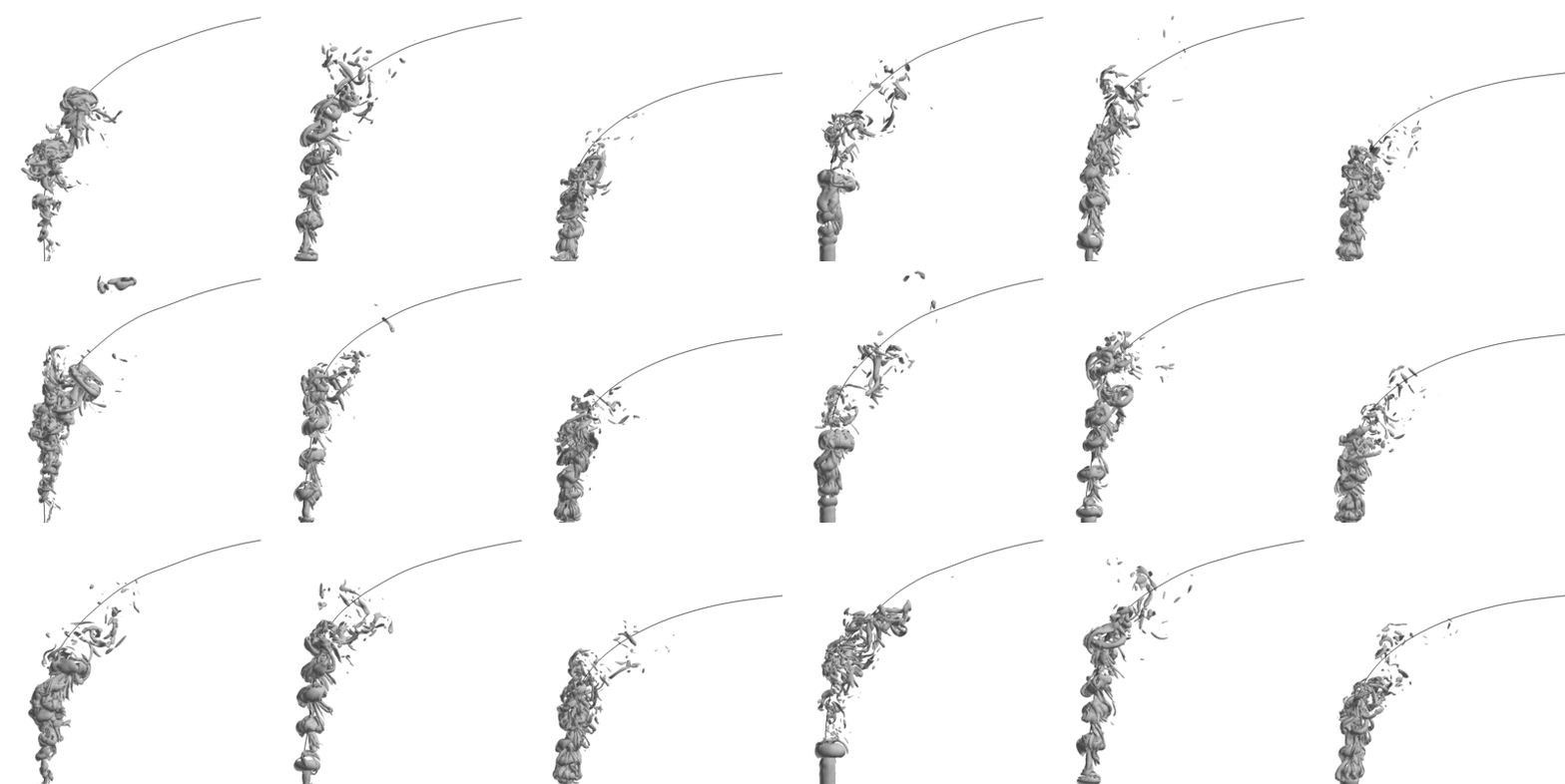
A three-dimensional Large Eddy Simulation (LES) of a H2-N2 jet penetrating into a cross flow of heated air under atmospheric conditions without reactions is performed. Such transverse JICF configurations are used in many practical applications such as fuel injection nozzles and dilution holes in gas turbine combustors to achieve high mixing between the jet and the cross flow. Typical of JICF flows are the interaction of the boundary flow and jet issuing from a nozzle. The interaction results in a complex, unsteady flow field with a multitude of length scales. Numerical solution to the JICF problem thus requires resolving all the relevant time and length scales associated. Due to the high Reynolds number nature of the JICF configuration, the cost of employing a fine numerical grid turns to be prohibitive. Block structured Adaptive Mesh Refinement (AMR) is therefore employed to resolve fine scale flow features only in regions of interest and thus reduce the computational cost of simulating the problem to manageable levels. A new heuristic criteria based on resolved level of turbulence and density gradients is used to determine regions where refinement is required. Results of the non-reacting studies indicate that the AMR is very effective in capturing all the unsteady flow features well known from the literature for a JICF configuration. Future goals include reacting flow studies of the same configuration using a mixture fraction based approach. Subgrid combustion closures for LES, coupling the laminar flamelet model with Linear Eddy Model (LEM) would also be developed as a part of the future effort.